Latest / The Redemption Project: Systems Explained
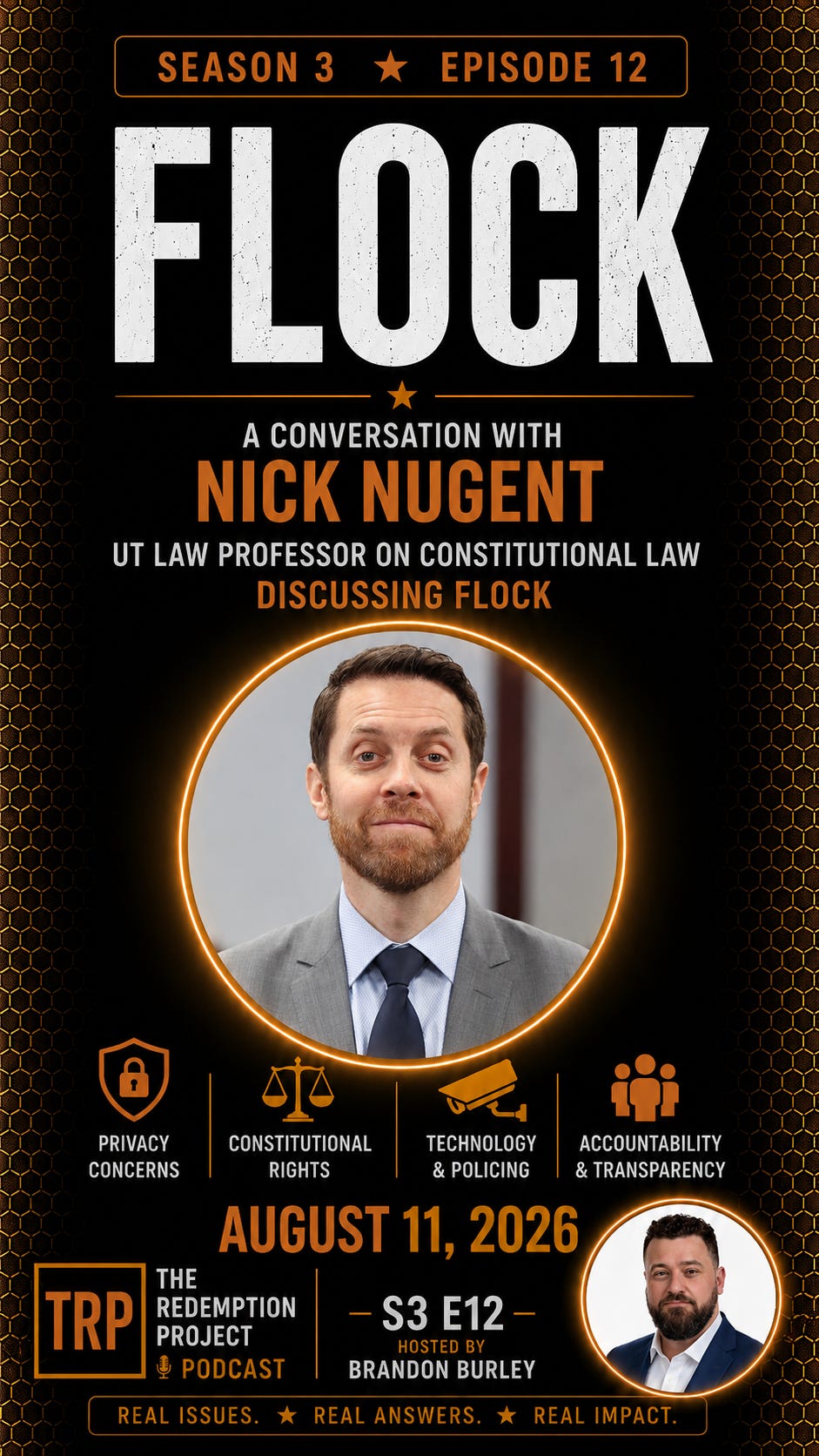
ALPR and Flock Technology Explained: When License Plate Readers Become a Privacy Debate
What are Flock cameras, and why are so many people suddenly concerned about them?
In this Season 3 Systems Explained episode, Brandon Burley talks with Nick Nugent, a University of Tennessee law professor who teaches technology law and constitutional law, about automated license plate readers, public safety, privacy and the difference between what may be legal and what kind of surveillance society we actually want.
The conversation separates two questions:
Is this constitutional?
And even if it is lawful, is this the policy Tennessee communities want?
Brandon brings his law enforcement…
Read the full description
background into the discussion, explaining why he once helped set up a limited Flock system but now has serious concerns about mass vehicle-location tracking, private third-party data collection, weak audit controls and the ability to map a person’s movements over time.
This is not an anti-police episode.
It is not a pro-surveillance episode.
It is a civic explainer about technology, public safety, privacy and the rules that should govern powerful tools before the tools become normal.
I am a retired detective and criminal justice / government educator based in Tennessee. I am a commentary write for Tennessee Lookout and a weekly columnist with Knox TN Today. My work examines public policy, public safety systems and civic responsibility. My reporting and commentary have also appeared in Governing, The Arizona Capitol Times, South Florida Sun Sentinel, Police1, among other state and regional outlets.
Get full access to The Redemption Project Newsroom at newsroom.theredemptionproject.news/subscribe
Short listen plan
No short plan yet. We need saved quotes in chapters with known start and end times, backed by a timed transcript.
The skinny
The skinny isn't ready yet — the transcript is, and you can read it now.
Do they have a right to not be surveilled in sort of every facet? I think they do. I think the right solution is legislative perhaps more than anything. Two separate issues, right? There is the legal issue. To what extent is this constitutional? To what extent is this consistent with the privacy guarantees of the Fourth Amendment and its state analogs in state constitutions or federal or state laws? That is one question. That's probably what I focus on… continue reading